


Step-by-Step Guide to Home Loan Procedure
Applying for a home loan is an exciting first step in your journey to owning your dream home. This need not be overwhelming with our step-by-step guide to the home loan procedure.
While there are some slight differences between lenders, the process outlined here will be the same for all banks. Following these steps will make your home loan application easy and stress-free.
Steps to Home Loan Application Process
The steps to complete the home loan process are as follows:
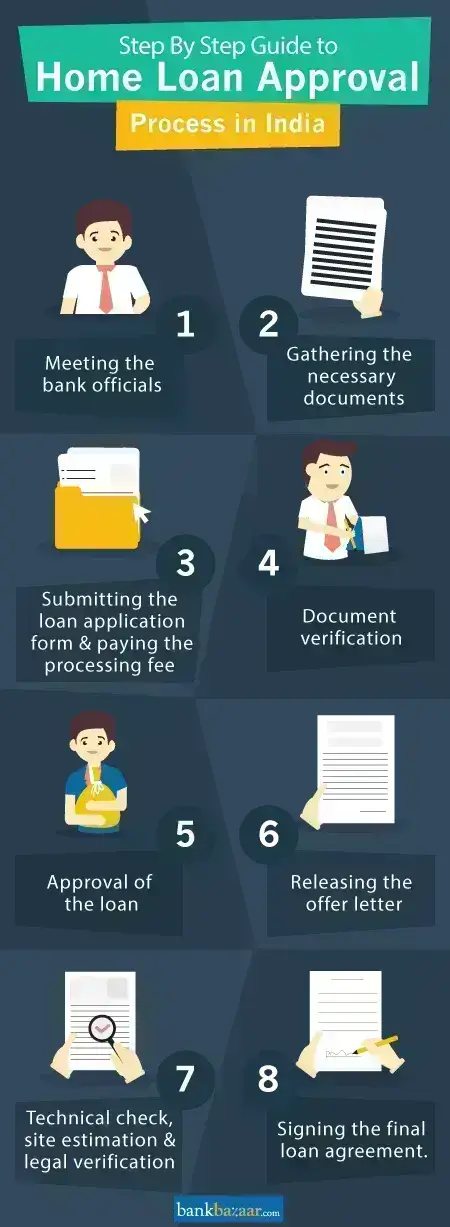
1. Submit the Home Loan Application
2. Pay the Processing Fee
3. Discussion with the Bank
4. Document Verification
5. Receive the Loan Offer Letter
6. Property and Legal Verification
7. Technical Inspection and Property Valuation
8. Finalise the Loan Agreement
9. Sign the Agreement and Loan Disbursal
Applying for a home loan involves several stages, from submitting the application to loan disbursal. Understanding each step can help you prepare the required documents and ensure a smoother borrowing experience.
1. Submit the Home Loan Application
Start by filling out the home loan application form and submitting the required documents.
Documents Required:
- Identity proof (Aadhaar, PAN, Passport, Voter ID, etc.)
- Address proof (Utility bill, Passport, Rental Agreement, etc.)
- Income proof (Salary slips, bank statements, ITRs)
- Employment or business proof
- Property documents (Title deed, Sale agreement, etc.)
2. Pay the Processing Fee
After submitting the application, pay the applicable processing fee. This fee covers administrative expenses such as:
- Credit assessment
- Document verification
- Property evaluation
Note: The processing fee is generally non-refundable and varies across lenders.
3. Discussion with the Bank
Once your application is received, the lender assigns a loan officer to review your case.
During this stage, the bank may:
- Verify your personal and financial details
- Discuss your repayment capacity
- Explain the loan amount, tenure, and applicable terms
- Seek clarification on any missing information
4. Document Verification
The lender thoroughly reviews all submitted documents to assess your eligibility.
The verification process typically includes:
- Income verification
- Credit score assessment
- Employment or business verification
- Property document verification
5. Receive the Loan Offer Letter
If your application is approved, the lender issues a loan offer letter containing the key loan details.
The offer letter generally includes:
- Approved loan amount
- Interest rate
- Loan tenure
- EMI amount
- Other applicable terms and conditions
6. Property and Legal Verification
Before approving the loan, the lender verifies the property offered as security.
The verification includes:
- Title verification
- Legal ownership check
- Verification of property-related approvals
- Confirmation that the property is free from legal disputes or encumbrances
7. Technical Inspection and Property Valuation
The lender appoints a technical expert to inspect the property.
The inspection covers:
- Construction quality
- Property condition
- Market value assessment
- Verification of the requested loan amount against the property's value
8. Finalise the Loan Agreement
After successful verification, the lender prepares the final home loan agreement.
The agreement specifies:
- Interest rate
- Repayment tenure
- EMI schedule
- Borrower's rights and obligations
- Charges and penalties, if applicable
9. Sign the Agreement and Loan Disbursal
The final step is signing the loan agreement.
Once the agreement is executed:
- The lender disburses the approved loan amount.
- The funds are usually transferred directly to the seller or builder, as applicable.
- Your home loan becomes active, and EMI repayments begin according to the agreed schedule.
Key Points To Remember
- Research for the banks offering the cheapest home loans.
- Read the bank's eligibility criteria carefully before entering the procedure to take home loan.
- Keep all the ID proofs, address proofs, employment proofs, and other details handy.
- Do not fake any of the documents, as this will only call for serious troubles.
- During the face-to-face meeting with the bank representative, ensure to carry the original documents.
- Just because the applicant is eligible for a home loan, it doesn't mean he/she can borrow a higher sum.
- The interest rates are negotiable. So, always use this opportunity for the best.
- There is a separate fee for processing the loan, reality check, site estimation, and other administrative works.
- Do not skip any stage during the valuation and verification process.
- Read every loan document carefully before signing.
- Once the loan is sanctioned, the original property papers are handed over to the bank and remain with them until the loan is completely repaid.
- It usually takes about two weeks to complete the process of home loan, provided that the documents submitted by the applicant are valid.



FAQs on Home Loan Procedure
1.What Is Full Disbursement?
A loan is disbursed based on the construction stage of the house property. In the case of ready/resale, the loan disbursement is full, meaning that the bank delivers full or complete payments to the recipient via cheque.
2.What information is required to fill out a home loan application form?
To complete a home loan application, you'll typically need personal details such as name, contact information, residential address, monthly or yearly income, educational and employment details, along with specifics about the property you intend to purchase.
3.How much processing fee should I expect to pay for a home loan?
Processing fees typically range from 0.25% to 0.50% of the loan amount. For instance, if you're applying for a loan of Rs. 15 lakh, processing fees could vary from Rs. 3,750 to Rs. 7,500, depending on the bank's policy.
4.What happens during the discussion stage with the bank for a home loan?
After submitting your application and documents, the bank may require a face-to-face interaction to gather more details about your financial situation and repayment capability, ensuring you're eligible for the loan.
5.What documents are assessed during the valuation process for a home loan?
During valuation, the bank scrutinises your residential and employment details, workplace and residence contact information, along with references listed in your application form, ensuring authenticity before proceeding.
6.How does the approval or sanction process work for a home loan?
The bank carefully evaluates your qualifications, income, employment stability, and other financial aspects to determine your eligibility for the loan. If all criteria are met, the bank communicates the maximum loan amount you qualify for, along with terms and conditions, via an official sanction letter.
7.What Is Part Disbursement?
If the house is "under construction", the loan payment is typically done in parts, which is officially termed as a part disbursement. When the loan is disbursed partly, the bank will not begin the EMIs right away. Since the loan EMI is calculated against the total loan sum at the agreed interest rate for a given duration, the repayment dues on part disbursement may not be applicable in the beginning.
8.How much is the processing time for a home loan?
The processing time for a home loan varies from bank to bank and depends on multiple other factors like the lending procedure of the institution, verification process, etc. In most cases, the processing time is between a few weeks to a month.
9.What do you mean by the sanction letter for a home loan?
Home loan sanction letters are the first step in the process of getting a home loan approved. They're signed by someone who has the authority to approve the loan, and they're given after they've looked at things like your credit score, income, ability to pay back the loan, and documents.
10.What is home loan prepayment?
Home loan prepayment is a service that allows you to pay off your loan (wholly or in part) before your loan term ends if you have more funds available. If you decide to prepay your loan, you have the option of: Lowering your EMI while keeping your tenure unchanged & Lowering your term while keeping your EMI unchanged.

Disclaimer
Credit Card:
Credit Score:
Personal Loan:
Home Loan:
Fixed Deposit:


Copyright © 2026 BankBazaar.com.