


Overview of Central Bank of India Fixed Deposit
A Central Bank of India Fixed Deposit offers guaranteed, capital-protected returns at a fixed interest rate for a tenure you choose, from 7 days to 10 years. Interest can be paid out periodically or reinvested for compounded growth, depending on your liquidity needs. Explore the scheme options and latest rates below.

Types of Central Bank of India Fixed Deposit Schemes
- Fixed Deposit scheme
- Money Multiplier Deposit Certificate (MMDC)
- Monthly Interest Deposit Receipt (MIDR)
- Quarterly Interest Deposit Receipt (QIDR)
- Cent-555 scheme
- Cent Tax Saving Deposit scheme
- Cent Suraksha Deposit scheme
Features of Central Bank of India Fixed Deposit Scheme
- Minimum deposit amount: Rs.100
- Range of maturity: 7 days to 10 years
- Interest calculated as Simple Interest
- Half-yearly interest payout in March and September
- Option for cumulative interest payment also available
- Tax Deducted at Source (TDS) will be deducted from the interest income exceeding Rs.50,000 per annum (as of July 2026)
- Facility for nomination available
- If the FD returns are more than Rs.20,000, the amount is transferred to the savings account linked to your FD account or given as a Demand Deposit (DD).
- If the returns are up to Rs.20,000, the returns can be received in cash.
- On the date of maturity, the deposits can be renewed automatically.
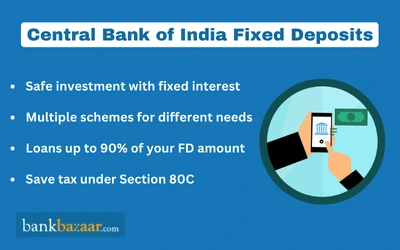
- Loans can be secured for against the deposit for up to 90% of the FD value.
- Joint account with two adults or one minor with another adult
- Maximum deposit amount for a minor: Rs.50,000
Features of Money Multiplier Deposit Certificate (MMDC)
- The interest income gets added to the principal amount which gets reinvested
- Minimum investment: Rs.100
- Maturity period: 6 months to 10 years
- You can apply for loan against FD.
Features of Monthly Interest Deposit (MIDR)
- Minimum amount of deposit: Rs.5,000
- Maturity period: 1 year to 10 years
- Loans can be availed against the deposit
- Monthly interest payout
Features of Quarterly Interest Deposit (QIDR)
- Quarterly interest payment
- Lower limit of deposit: Rs.5,000
- Facility to secure loans against the deposit: Available
- Maximum amount of deposit: Under Rs.1 crore
- Rate of interest: 6.50% p.a.
Features of Cent‑555 Scheme (Central Bank of India)
- Maturity period: 555 days
- Interest rate: 6.30% p.a.
- Interest is compounded on a quarterly basis
- Lower limit of deposit: Rs.1,000
- Upper limit of deposit: Below Rs.1 crore
- If a loan is secured against the deposit, you can prematurely withdraw from the FD account.
Features of Cent Tax‑Saving Deposit Scheme
- Joint accounts allowed
- You get tax benefits as per Section 80C of the Income Tax Act, 1961.
- Lock-in tenure: 5 years
- Deposit range: Rs.100 to Rs.1.50 lakh
- Interest rate: 6.00% p.a.
Features of Cent Suraksha Deposit Scheme (Central Bank of India)
- The scheme has two variants:
- Cent Suraksha Deposit (PMSBY)- Rs.177
- Cent Suraksha Deposit Yojana (PMSBY/PMJJBY)- Rs.4,317
- Yearly interest payout
- Interest is compounded at quarterly intervals
- Maturity period range: 5 years to 10 years
- TDS is applied to the interest income
- Interest rate: 6.00% p.a.
- Special interest rates:
- Senior Citizens: 0.50%
- Senior Citizens who is a former employee of the bank: 1.50% p.a.
- Current employee/ Former employee/ Spouse of a deceased employee: 1.00%
- You can withdraw from the deposit prior to the maturity date.
Premature withdrawal of the Central Bank Fixed Deposit
- Central Bank of India charges a flat 1% penal interest on premature withdrawal of a term deposit, irrespective of the deposit amount.
Central Bank of India FD Rates (Deposits below ₹3 crore)
Tenure | Regular FD interest rate (per annum) | Senior Citizen FD interest rate (per annum) |
7 days to 14 days | 3.00% | 3.50% |
15 days to 30 days | 3.50% | 4.00% |
31 days to 45 days | 3.50% | 4.00% |
46 days to 59 days | 4.25% | 4.75% |
60 days to 90 days | 4.00% | 4.50% |
91 days to 179 days | 4.25% | 4.75% |
180 days to 270 days | 5.00% | 5.50% |
271 days to 364 days | 5.00% | 5.50% |
1 year to less than 2 years | 6.10% | 6.60% |
2 years to less than 3 years | 6.25% | 6.75% |
3 years to less than 5 years | 6.00% | 6.50% |
5 years and above up to 10 years | 6.00% | 6.50% |
Note: The interest rates are effective from 10 May 2026.
Central Bank’s Eligibility Criteria to Open an FD Account
- Indian Citizens
- Hindu Undivided Family (HUF) member
- Individuals who are visually impaired
- Individuals who do have formal education
- Charity organizations
- Educational institutes
- Firms in partnership
- Traders and agents
- Societies and clubs
- Corporates
Documents Required to Open Central Bank of India FD Account
ID proof
(any one)
- Aadhaar Card
- Driving license
- Permanent Account Number (PAN) card
- Voter ID
- ID card from an authorized employer
Residential proof
(any one)
- Electricity or Telephone bill
- Salary receipt
- Bonafide letter attested by your employer or government body
- Aadhaar Card
Proof to determine age
(only for senior citizens and minors)
- Senior citizens (any one)
- Voter ID
- Pension slip
- Driver’s license
- Permanent Account Number (PAN) card
- Document stating retirement from a company
- Minors
- Government-validated birth certificate
- 2 color passport-size photographs of the applicant, if you are not an existing customer of the bank.
Summary
Central Bank of India offers a wide range of Fixed Deposit schemes, from the standard FD to tax-saving, monthly-income and premium variants, each suited to a different investment tenure and liquidity need. Interest rates vary by scheme and tenure and are revised periodically, so it is worth checking the latest rate table above before investing. Indian citizens, HUFs, firms and institutions can all apply, either at a branch or online.
FAQs on Central Bank Time Deposit schemes
1.What is a Central Bank of India Fixed Deposit?
A Central Bank of India Fixed Deposit is a term deposit that lets you invest a lump sum for a fixed tenure at a pre-determined interest rate. It suits investors who want safe, guaranteed returns with capital protection.
2. What types of Central Bank of India Fixed Deposit schemes are available?
Central Bank of India offers several fixed deposit variants, including the standard FD, MMDC, MIDR, QIDR, the Cent-555 scheme and the Cent Tax Saving Deposit and Cent Suraksha Deposit schemes. Each variant differs in tenure, minimum deposit and interest payout frequency.
3.What is the minimum amount required to open a Central Bank of India Fixed Deposit?
The minimum deposit for a Central Bank of India Fixed Deposit varies by scheme, with the standard FD needing the smallest starting amount and variants such as MIDR and QIDR requiring a higher minimum. Check the features listed above for the exact minimum under each scheme.
4.How is interest paid out on a Central Bank of India Fixed Deposit?
Interest on a Central Bank of India Fixed Deposit can be paid half-yearly, monthly or quarterly depending on the scheme, or reinvested cumulatively until maturity. The payout frequency is fixed at the time of account opening.
5.Is TDS deducted on Central Bank of India Fixed Deposit interest?
Yes, Central Bank of India deducts Tax Deducted at Source once your interest income from fixed deposits crosses the threshold prescribed under the Income Tax Act. You can submit Form 15G or 15H to the bank if your income falls below the taxable limit.
6.Can I withdraw a Central Bank of India Fixed Deposit before maturity?
Yes, Central Bank of India permits premature withdrawal of a fixed deposit, subject to the bank's prevailing penal interest policy. The applicable penalty depends on the rules in force at the time of withdrawal.
7.Is the Cent Tax Saving Deposit under Central Bank of India eligible for premature withdrawal?
No, the Cent Tax Saving Deposit carries a mandatory five-year lock-in and cannot be withdrawn early. This restriction lets depositors claim the tax benefit available under Section 80C.
8.Who is eligible to open a Central Bank of India Fixed Deposit account?
Central Bank of India Fixed Deposit accounts are open to Indian citizens, Hindu Undivided Families, partnership firms, trusts, societies and corporates, among other entity types. Eligibility criteria can vary slightly by scheme.
9.What documents are needed to open a Central Bank of India Fixed Deposit?
You need a valid identity proof such as Aadhaar, PAN or a driving licence, along with a residential address proof. Senior citizens and minors must also submit an additional age-proof document.
10.How can I apply for a Central Bank of India Fixed Deposit?
You can apply for a Central Bank of India Fixed Deposit by visiting your nearest branch with the required documents or by applying through the bank's online channels. Both routes require completion of standard KYC formalities.

Disclaimer
Credit Card:
Credit Score:
Personal Loan:
Home Loan:
Fixed Deposit:


Copyright © 2026 BankBazaar.com.