Tax on Gifts in India

The Parliament of India introduced the Gift Tax Act in 1958, and gift tax is essentially the tax charged on the receipt of gifts. The Income Tax Act states that the gifts whose value exceeds Rs.50,000 is subject to gift tax in the hands of the recipient.

What is Gift Tax?

A gift refers to the transfer of movable or immovable property, or any valuable item, from one person or organization to another without receiving any monetary compensation in return.
Gifts are often given as a gesture of love, goodwill, or celebration. However, it is essential to understand the tax implications of such transactions in India. The Government of India first introduced the Gift Tax Act in April 1958, later abolished it in 1998, and reintroduced it in a revised form in 2004.

Gift Tax in India

Types of Income Tax Gifts

The following is the list of income tax gifts:

Monetary Gifts

  1. Include all forms of money received, such as cash, cheques, drafts, and bank transfers.
  1. Any amount may qualify as a taxable gift received through the above-mentioned modes.

Movable Property Gifts

  1. Cover tangible, portable items, such as jewellery, shares, bonds, paintings, sculptures, and other valuable assets.
  1. When movable property is received for a price lower than its fair market value, the difference is considered a gift.
  1. Example: If you receive a painting at a price significantly below its true market value, the gap between the market value and the amount paid is treated as a gift.

Immovable Property Gifts

  1. These types of gifts include land, buildings, and residential or commercial real estate.
  1. If such property is received at a price less than its stamp duty value, the difference is treated as a taxable gift.

Exemptions on Gift Tax

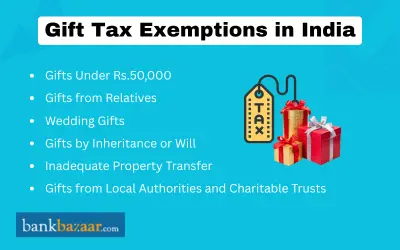
Under Indian income tax law, not all gifts are taxable. While gifts exceeding Rs.50,000 in value are generally taxed, several specific exemptions are provided depending on the nature of the gift, the relationship between the donor and recipient, and the occasion on which the gift is given.

  1. Gifts Up to Rs.50,000: If the total value of gifts received during a financial year does not exceed Rs.50,000, then the amount is fully exempt from tax.
  1. Property Received for Inadequate Consideration: the difference between the stamp duty value and the amount paid is treated as a taxable gift, when property is received for a price lower than its fair market value. This difference is exempt if it is less than Rs.50,000.
  1. Gifts from Relatives (Fully Exempt): Gifts from specified relatives are not taxable. These include:
  1. Spouse
  1. Siblings of the individual
  1. Siblings of the spouse
  1. Siblings of either parent
  1. Lineal ascendants or descendants of the individual
  1. Lineal ascendants or descendants of the spouse
  1. Spouses of all the relatives listed above

Note: Income generated from such gifted assets (e.g., interest, rent) may be taxable under clubbing provisions.

  1. Wedding Gifts: Gifts received by an individual on the occasion of marriage—whether in the form of cash, jewelry, gold, property, or securities, are fully exempt from tax.
  1. Gifts by Inheritance or Will: Any assets or money will not be considered under gift tax if it is received through inheritance or under a will.
  1. Gifts from Local Authorities or Charitable Organisations: Amounts received from local authorities, charitable trusts, foundations, universities, or registered charitable institutions are generally tax-exempt. This includes financial assistance provided to meritorious students or individuals undergoing medical treatment.
  1. Money Received in Contemplation of Death: Amounts received from a person in anticipation of their death are exempt from income tax, and it is similar to inheritances.

Gifts Received from Exempt Institutions:

Donee (recipient of the gift)

Donor

Occasion

Individual

Any person

Marriage of Individual

Individual

Relative

NA

Any person

Any person

By way of inheritance or under will

Any person

Individual

In contemplation of death of donor or payer

Any person

Local authority

NA

Any person

From any institution referred to Section 10(23C)

NA

Any person

Any trust registered under section 12A or section 12AA

NA

Any charitable or religious and other trust [Section 10(23C) (iv) (v) (vi) and (via)]

Any person

NA

Members of HUF

HUF

Any distribution of capital assets on total or partial partition of a HUF

Trust created or established solely for the benefit of the relative of the Individual

Individual

NA

Final Summary Table

Category

Exemption Criteria

Tax Status

General Limit

Gifts up to ₹50,000 from non-relatives in a financial year

Exempt

From Relatives

Gifts from defined relatives (see next table)

Fully Exempt

On Marriage

Gifts received by an individual on their wedding day

Fully Exempt

Inheritance/Will

Gifts received through inheritance or under a will

Fully Exempt

On Death of Donor

Gifts received due to donor’s death

Fully Exempt

Personal Gifts (e.g., assets)

Personal movable items, even above ₹50,000 (case-specific)

Conditionally Exempt

Partition in HUF

Distribution of assets during total/partial HUF partition

Fully Exempt

Taxable Value of a Gift

Here is the list of taxable value of various monetary and non-monetary presents:

Type of Gift

Taxable Value

Taxability Condition

Asset for consideration (e.g., jewellery, shares, paintings, sculptures, etc.)

Difference between Fair Market Value (FMV) and purchase price

Taxable if the difference exceeds Rs.50,000

Asset without consideration (gifted without any payment)

Fair Market Value (FMV) of the gifted asset

Taxable if FMV exceeds Rs.50,000

Immovable property for inadequate consideration (bought below stamp duty value)

Difference between Stamp Duty Value (SDV) and purchase price

Taxable if SDV exceeds purchase price by more than Rs.50,000

Immovable property without consideration (e.g., land, house received as gift)

Entire Stamp Duty Value (SDV) of the property

Taxable if SDV exceeds Rs.50,000

Monetary gifts (e.g., bank transfers, cash, cheque, etc.)

Total amount received

Taxable if the total amount from non-relatives exceeds Rs.50,000 in a financial year

How to Declare Gift Tax in India?

Gift tax in India is a direct tax charged to the gift recipient, who must report the value of taxable gifts in their Income Tax Return (ITR). The process involves assessing the gift’s value, declaring it correctly, and paying the applicable tax.

  1. Determine the Taxable Value: After accounting for any eligible exemptions or deductions, calculate the taxable amount of the gift.
  1. Report in the ITR: While filing your income tax return, declare the taxable value under the “Income from Other Sources” section.
  1. Compute Total Tax Liability: First add the taxable gift value to your overall income for that financial year. Next, to determine the payable tax amount, apply the income tax slab rate applicable to you.
  1. Pay the Tax: Along with your regular income tax obligations; make payment of the gift tax amount calculated.

Provisions Relating to Stamp Duty

The stamp duty value plays a key role in calculating gift tax on immovable property. Similar to Section 50C, this value is used to determine the taxable amount when a property is gifted.

Stamp Duty Value on Agreement Date: Stamp duty may sometimes appear higher due to factors, such as delays between agreement and registration.

When the agreement date and registration date differ, the stamp duty value as on the agreement date can be used for gift tax calculations, depending on the following factors:

  1. The agreement and registration dates are not the same.
  1. Part or full payment is made through an account payee cheque, bank draft, or electronic transfer on or before the agreement date.

Disputing Stamp Duty Value: If the taxpayer challenges the value adopted by the stamp duty authority:

  1. The tax officer must refer the matter to a Valuation Officer (VO).
  1. The VO allows the taxpayer to present their case after examining the records and issues a written valuation order.
  1. The lower value determined by the VO may be considered for gift tax purposes.

Relaxation under Section 56(2)(x):

A tolerance limit of up to 10% of the consideration is allowed if the stamp duty value exceeds the consideration received for the gifted property. The excess amount within this limit will not be treated as income from other sources.

FAQs on Gift Tax

  • What is the value threshold for taxable gifts?

    Gifts above Rs 50,000 in a financial year are taxable—below that from non-relatives are exempt.

  • How much gift received from relative is exempt from tax in India?

    In India, any amount of gift received by an individual from relatives is exempt from tax.

  • How much gift money can be sent from India under LRS?

    Under the Liberalised Remittance Scheme (LRS), a resident can gift up to USD 250,000 per financial year to an NRI.

  • Is TDS applicable on gift?

    Yes, as per Section 194R, TDS at 10% applies to promotional or professional gifts exceeding Rs.20,000.

  • Is Gift Tax a direct tax?

    Yes, Gift Tax is a direct tax and is levied under the Income Tax Act, 1961.

  • Are gifts received by minors taxable?

    Yes, such income is clubbed with the parent earning the higher income, subject to specific exemptions.

  • What about the Income Earned from a Gift?

    According to Income Tax rules, income earned from a gift will not be exempted from tax and will be treated as individual income and will attract tax.

  • Is a gift from a friend taxable?

    Yes, a gift received from a friend is taxable. This is applicable only if its value exceeds Rs.50,000 in a financial year. Any amount below Rs.50,000 is tax-free.

  • What is the limit on cash gifts received from parents?

    Gifts received from parents (who qualify as relatives) are fully exempt from tax, irrespective of the amount. Under Section 269ST, receiving cash exceeding Rs.2 lakh in a single transaction, or in aggregate from a person in a day, is prohibited. Violating this rule may attract penalties.

  • Can I save tax by transferring money as a gift to my wife's account?

    No, although a gift given to a spouse is not taxable for the wife, the amount is subject to clubbing provisions. Any income earned from the gifted amount (such as interest) will be taxed in the husband’s hands, not the wife’s.

Disclaimer
Display of any trademarks, tradenames, logos and other subject matters of intellectual property belong to their respective intellectual property owners. Display of such IP along with the related product information does not imply BankBazaar's partnership with the owner of the Intellectual Property or issuer/manufacturer of such products.