


Beti Bachao, Beti Padhao Yojana
The Indian Government initially started the Beti Bachao Beti Padhao movement. It was essentially a joint effort between the Ministry of Health and Family Welfare, Ministry of Women and Child Development & Ministry of Human Resource Development. In October 2015, the Ministry of Health and Family Welfare, the Ministry of Women and Child Development (MWCD), and the Ministry of Human Resource Development jointly introduced the Beti Bachao, Beti Padhao (BBBP) scheme to address the declining Child Sex Ratio (CSR) in India.
On 23 July 2018, the government revised the minimum annual deposit for the Sukanya Samriddhi Yojana account from Rs. 1,000 to Rs. 250. Currently, the rate of interest offered by the SSY scheme is 8.25% p.a.
Eligibility for the Beti Bachao Beti Padhao Scheme
The following conditions determine eligibility for the Beti Bachao Beti Padhao scheme:
- Family with a Girl Child: The scheme is applicable to families that have at least one girl child under the age of 10 years.
- Sukanya Samriddhi Account (SSA): The family should have a Sukanya Samriddhi Account (SSA) opened in any bank, specifically in the name of the girl child. The SSA is a government-backed savings scheme aimed at promoting financial security and education of girls.
- Indian Citizenship: The account must be opened for a girl child who is an Indian citizen. Non-Resident Indians (NRIs) are not eligible for this scheme.
Documents Required for Beti Bachao Beti Padhao (BBBP) Scheme
When applying for the Beti Bachao Beti Padhao scheme, the following documents are typically required:
- Birth Certificate: A birth certificate issued by a hospital or a recognized government authority, proving the birth of the girl child.
- Proof of Identity of Parents: Documents such as Aadhaar Card, Ration Card, or any other government-issued identity proof of the parents.
- Proof of Address: Documents like Passport, Driving License, or utility bills (water, telephone, electricity, etc.) serving as proof of the family's residential address.
- Passport Size Photograph: You need passport-sized photographs of the girl child and her parents for documentation.
Beti Bachao Beti Padhao - Objectives
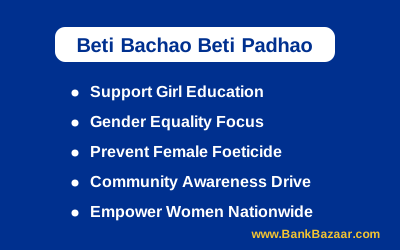
The scheme focuses on the following main objectives:
- Protection and survival of the girl child.
- To remove selective elimination that is gender biased.
- Education of the girl child.
Benefits of the Beti Bachao Beti Padhao Scheme
- Provision for a girl child to open an account for future financial security.
- The Income Tax Act of 1961, Section 80C, exempts the account, keeping it entirely tax-free.
- Offers a competitive interest rate, allowing withdrawal only when the girl child turns 18.
- Provides an easy savings facility for daughters facilitated by parents or guardians.
- Introduces a savings scheme called Sukanya Samriddhi Account (SSA) under the scheme.
- Generates awareness about issues related to girls and women.
- Improves the delivery of welfare services for women.
- Addresses the decline in Child Sex Ratio (CSR) in critical states and regions.
- Offers an attractive 8.1% interest rate per annum on Sukanya Samriddhi Yojana accounts.
- Sets a maximum deposit limit of Rs. 1.50 lakh per annum.
- Promotes better education and inclusion opportunities for women.
Beti Bachao Beti Padhao Program Expansions
- Guaranteeing an annual 1% rise in secondary enrolment and skill development for girls and women.
- Ensuring the completion of schooling, skill development, and entry into diverse occupations for teenagers.
- Creating awareness about menstrual hygiene and safety.
- Advocating for the eradication of child marriages.
Beti Bachao Beti Padhao - Target Group
The scheme targets the following groups:
- Primary: Parents, pregnant mothers, newly married couples, young married couples, and lactating mothers.
- Secondary: Diagnostic centres, nursing homes, private hospitals, doctors, in-laws, adolescents, and youth.
- Tertiary: General public, industry associations, medical associations, media, voluntary organisations, religious leaders, women SGHs, frontline workers, PRIs, and officials.
How to apply for the Beti Bachao Beti Padhao Scheme
To apply for the Beti Bachao Beti Padhao (BBBP) scheme and avail its benefits, follow these steps:
- Step 1: Visit the Designated Bank or Post Office
Go to the bank or post office where the Sukanya Samriddhi Account (SSA) under the BBBP scheme is available.
- Step 2: Obtain and Fill the Application Form
Request and fill in the application form for BBBP/SSA. The form can typically be filled out manually.
- Step 3: Attach Required Documents
Gather all the necessary documents, including the birth certificate of the girl child, proof of identity and address of the parents (Aadhaar card, ration card, etc.), and passport-sized photographs.
- Step 4: Submit the Documents
Submit the filled application form along with the required documents to the same bank or post office. The Sukanya Samriddhi Account must be opened in the name of the girl child.
Account Transfer: You can easily transfer the Sukanya Samriddhi Account from one bank or post office to another if needed.
Different Strategies undertaken by BBBP to achieve its objectives
The following strategies collectively contribute to the success of Beti Bachao Beti Padhao in addressing the declining Child Sex Ratio and promoting the protection and empowerment of the girl child in India.
- Focusing on Gender-Critical Districts: The program targets districts with significant gender disparities to implement intensive actions and interventions aimed at improving the status of girls and women.
- Prioritizing Cities with Low Child Sex Ratio: BBBP gives special attention to cities and areas with low child sex ratios, where the number of girls is significantly lower than boys, to take integrated action and address the issue effectively.
- Public Discourse and Awareness: The initiative emphasizes forwarding and discussing the problem of declining Child Sex Ratio in public forums, conferences, and debates. This approach aims to raise awareness rapidly and garner support for addressing the issue.
- Innovative Local Approaches: BBBP employs innovative and culturally sensitive techniques tailored to the specific needs and sensibilities of each local community. This ensures that the program's initiatives resonate with the local population and are more likely to be effective.
- Community Engagement and Participation: The program encourages active involvement and participation from communities to contribute to their development, especially in promoting the well-being and growth of the girl child.
- Communication Campaigns: BBBP initiates communication campaigns that promote the importance of the girl child's development and education. These campaigns aim to change mindsets and encourage a more positive attitude towards girls.
- Challenging Gender Stereotypes: The initiative takes on the task of challenging existing gender stereotypes and harmful social norms that perpetuate discrimination and bias against the girl child. By challenging these norms, BBBP aims to create a more inclusive and equal society.
- Training Local Bodies and Groups: BBBP provides training and support to local governing bodies and community groups, empowering them to act as catalysts for social change. By equipping them with the right knowledge and tools, they can contribute effectively to the program's goals.
Schemes under Beti Bachao Beti Padhao
The popular schemes that have been introduced under the BBBP scheme are mentioned below:
- Dhanalakshmi scheme
- Kanyashree Prakalpa Yojana
- Ladli scheme
- Ladli Laxmi Yojana
- Balika Samridhi Yojana
- Sukanya Samridhi Yojana
Beti Bachao Beti Padhao Purpose
The BBBP scheme, aims to prevent sex selective abortion and thereby, not only ensure survival of the girl child but also her protection, education and empowerment. The scheme, therefore, aims at multi-sectoral action to not only arrest but also reverse the declining CSR in 100 districts.
The scheme is aimed at achieving the following objectives:
- Change in the mindset of parents of bringing up a girl child as ‘paraya dhan’
- Retention of girls in schools
- Challenge gender stereotypes and promote equality between boys and girls
- Stop child marriage and dowry
- Provide a safe environment for girls
- Advocate higher education and simple weddings
- Support girls’ right to inherit property
- Celebrate the girl child
Beti Bachao Beti Padhao Campaign across 100 Districts
The Beti Bachao, Beti Padhao campaign is being implemented in 100 select districts across the country which have low CSR.
One district is each state in India has been identified in Census 2011 based on the following criteria:
- Above national average but increasing CSR (5 states)
- Above national average but declining CSR (8 districts)
- Below national average
Budget allocation and administration for Beti Bachao Beti Padhao Campaign
The government allocated Rs.100 crore for the Beti Bachao, Beti Padhao campaign under the ‘Care and Protection of Girl Child - A Multi Sectoral Action Plan’. However, the scheme is estimated to cost around Rs.200 crore. The MWCD, responsible for budgeting the scheme, transfers the allotted funds to the state. Additional funds are set to be mobilized with assistance from several state governments in addition to corporate social responsibility programmes.
The secretary of MWCD heads a national task force which administers the Beti Bachao, Beti Padhao (BBBP) scheme while the chief secretary, the head of the state task force monitors the progress of the scheme across the state. Likewise, collectors will lead various officials in the district to ensure proper implementation of the scheme. District collectors have to document several CSR-related indicators.
The impact of the Beti Bachao, Beti Padhao scheme will be evaluated at the end of the 12th five year plan to pave way for corrective measures, if any. The said scheme will be assessed on several parameters such as ratio of male & female children, ultrasonography machines and complaints under PNDT act among others.
Beti Bachao, Beti Padhao Implementation
The Beti Bachao, Beti Padhao (BBBP) scheme is aimed at achieving the aforementioned objectives by taking the following measures:
- Ensure implementation of a wide-reaching and targeted social mobilization campaign to pave way for equal respect for the girl child in all respects including education.
- Trigger healthy debates and public discourse on the issue of declining CSR and stress on its improvement through social media across the country.
- Specific focus on select ‘gender critical’ districts which have low CSR and therefore, need an integrated approach besides intensive and coordinated efforts to achieve the desired results.
- The scheme aims to train both panchayati raj institutions and urban local bodies to work in the right direction to engineer positive social change in tandem with its stated objectives.
- Ensure seamless multi-sectoral convergence at district/block level for proper implementation of the scheme.
Sukanya Samriddhi Top Pages
FAQs on Beti Bachao, Beti Padhao Yojana
1.Where was the Beti Bachao Beti Padhao scheme launched?
The Beti Bachao Beti Padhao campaign was introduced on 22 January 2015, when Indian Prime Minister Narendra Modi addressed the public in Panipat, Haryana.
2.What is the objective of the Beti Bachao Beti Padhao scheme?
The primary objective of the Beti Bachao Beti Padhao scheme is to raise awareness about the need to protect, support, and educate young girls. Additionally, it is aimed at reducing social crimes against women, such as dowry, child marriage, female infanticide, and more.
3.What is the interest rate offered on the Beti Bachao Beti Padhao scheme?
Currently, the interest rate offered on the Beti Bachao Beti Padhao scheme is 7.6% p.a. for the deposits made into the Sukanya Samriddhi (SSY) Account.
4.Is there a website for the Beti Bachao Beti Padhao scheme?
Yes, the government has established a BBBP website outlining the beginning, management, and accomplishments of the scheme. The same name is also used for its YouTube channel.
5.Who is eligible for the Beti Bachao Beti Padhao scheme?
If a girl is an Indian resident and under the age of 10 years, she is eligible for the Beti Bachao Beti Padhao scheme.
6.Will I receive any benefits from the Beti Bachao Beti Padhao scheme?
No, Beti Bachao Beti Padhao is not a Direct Benefit Transfer scheme. No deposits or transfers of cash are done. Any such claim made by any individual is untrue and fake. Such claims should be brought to the district authorities' attention.
7.Which Indian districts have been selected for this BBBP scheme's low girl ratio?
As many as 100 districts have been identified where the gender numbers are staggeringly low, with a minimum of one district in every state and union territory. These districts have extremely low girl child populations in comparison to the national average based on the 2011 Indian Census.
8.What types of services are provided through the Beti Bachao Beti Padhao scheme?
Under the Beti Bachao Beti Padhao scheme, various services such as health and sanitary initiatives, food and nutrition programmes for pregnant and lactating mothers, girl child felicitation, and more.
9.Does the Beti Bachao Beti Padhao scheme cover all Indian states?
Yes, the Beti Bachao Beti Padhao scheme all Indian states and union territories.
10.When is the National Girl Child Day observed?
The National Girl Child Day observed every year on 24 January.
11.How does the BBBP scheme aim to address the declining Child Sex Ratio (CSR)?
The BBBP scheme addresses the declining Child Sex Ratio by creating awareness about the importance of the girl child, conducting campaigns to challenge gender stereotypes, and implementing intensive actions in districts with low CSR.
12.Which ministries are involved in the implementation of the BBBP scheme?
The BBBP scheme is a combination of three ministries: Women and Child Development, Health & Family Welfare, and Human Resource Development.
13.What is the target audience of the BBBP scheme?
The BBBP scheme targets the entire country, but it categorizes the target audience into three groups: primary groups (young couples, pregnant mothers, parents), secondary groups (youth, doctors, in-laws, etc.), and tertiary groups (general public, frontline workers, officials, etc.).
14.What documents are required to apply for the BBBP scheme?
To apply for the BBBP scheme, you typically need a birth certificate issued by a hospital or recognized government body, proof of identity of the parents (such as Aadhaar card or ration card), proof of address, and a passport-size photograph.
15.What are the different strategies undertaken by the BBBP scheme to achieve its objectives?
The BBBP scheme undertakes strategies such as focusing on gender critical districts, prioritizing cities with low Child Sex Ratio, initiating communication campaigns, challenging gender stereotypes, and training local governing bodies and groups for social change.
16.How can individuals contribute to the BBBP scheme's objectives?
Individuals can contribute to the BBBP scheme by participating in awareness campaigns, promoting the education and empowerment of the girl child, and challenging gender stereotypes within their communities.
17.Are there any specific schemes introduced under the BBBP initiative?
Yes, several schemes have been introduced under the BBBP initiative, such as Sukanya Samriddhi Yojana, Balika Samridhi Yojana, Ladli Laxmi Yojana, Kanyashree Prakalpa Yojana, and Dhanalakshmi scheme, among others.
18.What is the societal impact of the BBBP scheme?
The BBBP scheme benefits not only the girl child but also the entire society by addressing the need for a change in the approach towards women and promoting equal facilities and opportunities. It aims to create a society free from gender discrimination and empower all its citizens.
19.How does the BBBP scheme utilize national media campaigns to create awareness?
The BBBP scheme utilizes national media campaigns to celebrate the birth of the girl child, promote education and health-related reforms, and create awareness about gender-based discrimination. These campaigns use a 360-degree media approach to reach a wider audience.
20.How can individuals register and apply for the Beti Bachao Beti Padhao scheme?
Individuals can register and apply for the BBBP scheme by visiting the bank or post office where the scheme is available, filling out the application form for BBBP/Sukanya Samriddhi Account (SSA), and submitting the required documents.
21.How has the BBBP scheme contributed to the protection and empowerment of the girl child in India?
The BBBP scheme has contributed to the protection and empowerment of the girl child in India by creating awareness, implementing targeted actions in gender critical districts, and promoting education and equal opportunities. It has played a significant role in addressing gender-based discrimination and promoting a better future for girls.

Disclaimer
Credit Card:
Credit Score:
Personal Loan:
Home Loan:
Fixed Deposit:


Copyright © 2026 BankBazaar.com.