


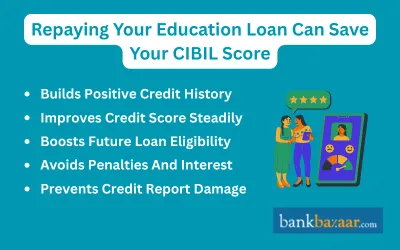
How Repaying Your Education Loan Can Save Your CIBIL Score?
CIBIL - the Credit Information Bureau of India Limited - is the organisation that banks and lenders go to in order to determine your credit-worthiness as it keeps a record of all the loans and credit cards that are registered under your name. It tracks your performance on these loans and credit card payments in order to create a realistic picture (as a numerical score and report) of whether you will be able to - or can be trusted to - repay a loan or credit card bill in the future.

It Takes into Account Factors Like:
- Payment regularity and default rate on loan repayments, EMI payments and credit card bill payments.
- Defaulted loans for which you've stood as a guarantor.
- The amount of credit limit you've utilized on your card - the higher, the worse for your score, as it shows that you're pretty dependant on credit.
- A large number of personal loans and credit cards as compared to secured loans.
- Many recently approved loans or credit cards.
Let's focus on the first thing that CIBIL looks at - payment regularity and default rate on loan repayments, EMI payments and credit card bill payments.
An education loan is viewed by CIBIL as any other loan - it is a line of credit that was extended to you by a bank on the condition that you would honour your EMI payments when they become due.
Harshala Chandokar, a Senior Vice President at CIBIL said that "The education loans have to be paid once one completes his/her course and gains employment." Your life goals while taking out an education loan may have covered this possibility, where you finish your studies and use the grace period to find a job and start earning - thus enabling you to repay when EMIs become due.
More often than not, especially overseas, this plan fails and you are rendered unable repay your student loan / education loan. Mr. Chandokar went on to say that "Also, like any other loans and credit cards, education loans are also reported to CIBIL and get reflected in the borrower's CIBIL Report and impact the CIBIL TransUnion Score." What this means is that if you're stuck unable to pay - it will affect your ability to get loans and credit cards approved in the future.
The outstanding credit for education loans was Rs.63,800 crore as on March 31st, 2015, according to a CIBIL report. Education loans are usually taken out during the 4th quarter of the year. The report also stated that more loans are being taken out than ever before, with over 1,30,000 education loan accounts being opened in the 4th quarter of 2014. The average sanctioned amount per loan is also on the rise. It is currently around Rs.6,00,000, up from Rs.4,50,000 in the 4th quarter of 2013. Loans of over Rs.5,00,000 have also gone up by 30%, and loans for below Rs.1,00,000 has reduced to under 10% of the total loans sanctioned. This means that more people are taking larger loans, and this is a cause for concern for banks who have no security against recovering them.
There is some positive news, as the default rate (or delinquency rate) for education loans has showed a decline. The report states that "Delinquency for 90+ days amount overdue was around 3.50 per cent in fourth quarter of 2013 which has lowered to 2.70 per cent in fourth quarter of 2014."
7 Tips to Keep in Mind While Applying for an Education Loan
If you want to get a degree from a renowned institution in India or overseas, you definitely have to plan your finances, as education can be quite expensive. Even though there are institutions that offer scholarships, a majority of students are not able to secure them and therefore they have to opt for educational loans. Here are a few tips you can follow if you are applying for an education loan:
- Start the loan procedure way in advanceIf you have decided to join your desired educational institution, it is better to start your process way ahead of time. The loan process takes a lot of time as it involves heavy document verification, approval from the bank, and so on. Applying for the loan in advance will save you from any hassles later. Hence, it is ideal to apply beforehand.
- Be thorough with paperworkLoan application requires a lot of paperwork and you should start collecting them at the earliest to save last minute hassle. Make sure you arrange all the documents properly as it will help you speed up the loan process.
- Browse and compare interest ratesOnce you have decided to get an education loan, you should check the interest rates from a number of lenders before coming to a decision. It is better to compare the interest rates as each lender offers different rates. After you have completed the research and decided on a bank or a lender, you should go one step ahead and even negotiate on the rate. It is completely normal to ask the lenders to waive off or give a discount on your loan processing fee and other charges. This will surely save you a good amount of money.
- Look out for loopholes in your loan documentsYou should be extra careful at the time of signing the loan documents and watch out for loopholes or hidden charges. Make sure to read the documents in detail multiple times and double check on the interest rate, loan amount, payment structure, penalties and conditions for pre-payment, the disbursement process, etc.
- Learn about your tax benefitsYou are entitled to tax benefits on your education loan under Section 80E of the Income Tax Act. The deduction is only available for the full interest on your loan from your taxable income. It must be noted that the deduction is applicable only to the interest and cannot be availed on the principal amount which you pay towards your education loan.
- Know the results of defaulting paymentsAt the time of finalising the loan, you should be aware of the penalties of not paying off the loan at all or not paying off the loan same as per the decided schedule. For some reason, if you are not able to repay the loan amount, you should first inform the lender at the earliest as they can help get you more time for the payment. In case you turn out to be a defaulter, your guarantor will need to make the payment. If you are unable to pay off the dues, your credit score will take a hit in a big way and will be down by several points.
- Check whether you can pre-pay the loan amountWhen you are pre-paying your education loan, it is better that you do a detailed cost-benefit analysis as you might have to pay a penalty. In addition, to reduce your monthly EMI amount, you should check with your bank about starting the repayment of interest while you are studying.
Hope all the above tips will come in handy when you are applying for an education loan.
Having a low CIBIL score just out of college can have a lot of negative implications on your financial well-being.
- If you're looking to build a start-up company - using the contacts, knowledge and ideas you've acquired from college - having a low CIBIL score will mean that you won't be able to raise capital in the form of a loan from a bank. Effectively delaying the plans you made at college.
- You will have to work twice as hard - to pay off the loan, and to improve your credit rating.
- Most of your salary will be used up paying off education loans and the interest that compounds on it.
- Once you clear your loans and are free of debt, you'll need to take on even more debt to improve your CIBIL score.
- A low CIBIL score is also being looked at by some employers as a measure of economic stability which translates into trustworthiness.
- A low CIBIL score means no credit card, which means a lot more difficulty in supplementing your income with short-term credit.
In an effort to counter the problems that defaulting on education loans brings, R Gandhi, the Reserve Bank of India's Deputy Director has requested CIBIL to counsel the youth taking loans on good credit behaviour.
Some Tips to Avoid Defaulting on Education Loans
- Take a smaller loan amount: As far as possible, try to fund your own education by requesting family members for assistance, or applying for scholarships. Scholarships are widely unused and a majority of prospective students qualify for some scholarship or the other.
- Make tuition fees a parameter when selecting a college: Most students focus on the credentials of the institute they wish to join, and don't even consider other institutes that have the same standing offering similar courses. Considering tuition fees as a parameter could go a long way in ensuring your life after college is less difficult than it could've been.
- Get a part-time job: This applies to you if you're studying abroad, as part time jobs in India don't pay an amount that facilitates savings. Getting a part time job not only adds a decent amount to your bank balance thus reducing your dependency on credit, but also gives you valuable, verifiable experience that you can use on your resume. Companies prefer candidates with experience and exposure to real world work environments, which most college students don't.
- Plan with incredibly meticulousness: If you're left with no other choice than to take a huge education loan, the smart move would be to plan out the next 5 years with incredible detail. Plan what you'll do in college, research what your course will qualify you for, research companies hiring for those qualifications, contact them if possible and request an internship, plan your expenses by scouring blogs and calculating the cost-of-living with the average salary for a fresher. You'll literally need to plan out every aspect of your life till at least 2 years after college to get you started on the path to paying off your EMIs properly. Once you're in that routine, you'll pretty much be able to take care of yourself, but till you get there - your time and energies need to be regimented or you'll fall into the pit of debt that has claimed so many.
Some Points to Keep in Mind Regarding CIBIL and Lenders
- The report contains a numerical representation of your credit-worthiness on a scale from 0 - 900. Loans and credit cards only get approved for scores above 750.
- For those with a credit history of less than 6 months, an index score between 1-5 determines their risk level. 1 and 2 is high risk, 3 is medium risk, 4 and 5 are low risk.
- The report also contains comments and remarks left by lenders about your performance - it's always good to stay in their good books and make payments on time.
- The credit history - positive or negative - stays for a minimum of 7 years if left untouched.
- Scores can also be represented as "NA" (Not Applicable) or "NH" (No History).
- You can greatly lower the chances of falling in to a pit of debt by avoiding taking a credit card while you also have an education loan running.
Disclaimer
Display of any trademarks, tradenames, logos and other subject matters of intellectual property belong to their respective intellectual property owners. Display of such IP along with the related product information does not imply BankBazaar's partnership with the owner of the Intellectual Property or issuer/manufacturer of such products.


FAQs on Repaying Your Education Loan Can Save Your CIBIL Score
1.Is education loan included in CIBIL score?
With a few minor exceptions to repayment terms, student loans function similarly to other types of loans. Making your EMI payments on time will have a positive impact on both your credit history and CIBIL score.
2.How does the student loan settlement repayment process work?
After graduation, students can start making payments on their education loans. You are granted a 'moratorium period,' during which time repayment may start 6 to 12 months after graduation. However, interest will start to accrue as soon as you receive the loan amount. Therefore, the sooner you begin repaying, the lower the amount will be.
3.Is a loan's partial payment the same as its settlement?
No, part-payment of a loan happens if the borrower wishes to lower the principal amount of the loan in order to ultimately decrease the interest burden and has the ability to repay the loan in full. A loan settlement occurs when the lender realises that the borrower cannot repay the loan and agrees to accept a sum that is less than the total amount owed.
4.What is the lowest CIBIL score needed to be eligible for a student loan?
For an education loan, the lenders require a minimum CIBIL score of 685. Government banks, however, occasionally might accept a CIBIL score lower than 685 if it relates to credit cards. However, private lenders are less accommodating when it comes to CIBIL issues and will typically reject a loan application if the score is lower than 685.
5.I do not have a co-signer, but I would like to apply for an education loan. How do I proceed?
If you don't have a co-signer, you can still get a loan from other sources because some lenders will still approve loans without one.
6.Is It possible to apply for an education loan without a credit score?
Yes, to apply for an education loan, you can choose a co-applicant with a high CIBIL.
7.Does the CIBIL score change after a loan rejection?
Lenders check the CIBIL score of an applicant. A hard inquiry is one that is made by a bank or credit institution. Your CIBIL score will undoubtedly drop as a result of a hard inquiry, so you should refrain from applying for multiple loans at once.
8.What impact does paying off student loans have on credit scores?
Paying education loan won’t impact your CIBIL score.
9.Is it better to repay education loan early?
Yes, it is better to repay the education loan as early as possible.
10.I want to apply for an education loan but I don’t have a co-signer. What to do?
If you don’t have a co-signer, you can borrow a loan from the other resources as there are different lenders who offer loans to those who don’t have co-signer.
11.What are the expenses covered by the education loan?
Education loan can be used to pay library, lab, hostel, and tuition fees.
12.Who can be my co-borrowers?
Parents or guardians can be your co-borrowers. In case the applicant is married then his or her spouse can be a co-borrower.
CIBIL Score Requirements for Loans

Disclaimer
Credit Card:
Credit Score:
Personal Loan:
Home Loan:
Fixed Deposit:


Copyright © 2026 BankBazaar.com.